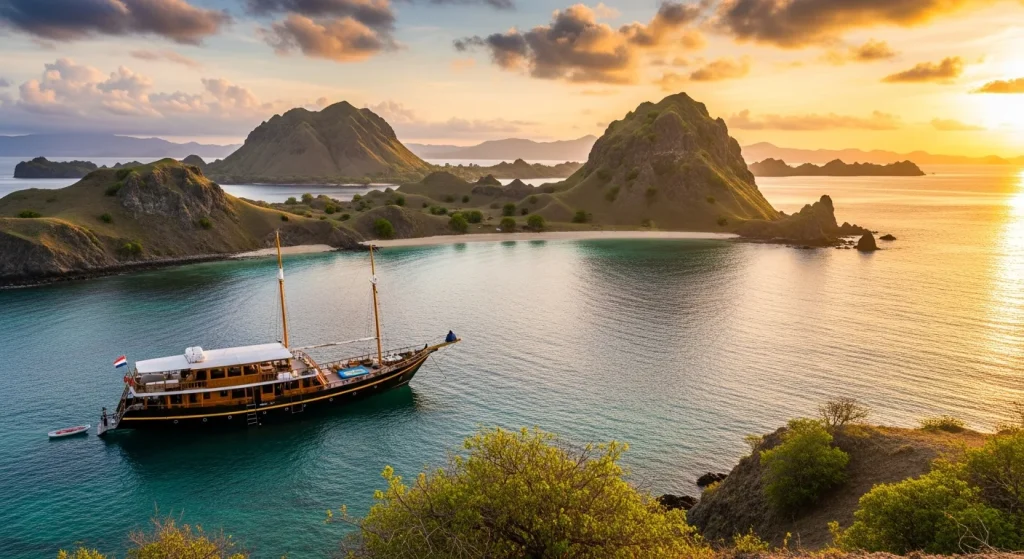
Manta Point Komodo — the site marked on charts as Karang
Makassar — is a 1.5 km drift over a shallow rubble plateau where reef
manta rays gather to feed and be cleaned, with sightings possible
year-round and peaking from December to February when plankton is
thickest. On our 5-day route it is Day 3 at 07:00 sharp, before
the day fleet arrives, with Day 4 held as a second attempt if the first
drift is quiet. This article covers the season, the odds, the technique,
and the etiquette — the four things that decide whether you swim with
mantas or watch other people’s drone footage of them.
I am Jo Rangga. I have drifted Karang Makassar several hundred times
since 2016 and logged the sightings on every pass, and I will give you
the honest numbers rather than the brochure ones.
What Manta Point actually is
Karang Makassar is not a wall or a coral garden. It is a long,
current-swept plateau of rubble and sand, 3–12 m deep, running
north–south in the strait east of Komodo Island. The current that makes
it uncomfortable for coral makes it perfect for Mobula alfredi
— reef manta rays with wingspans of 3–4 m (large individuals approach 5
m) — which come to feed on plankton carried through the strait and to
hover at cleaning stations where wrasse pick them over. You do not swim
to the mantas; the current carries you down the plateau past them. That
is the drift.
Komodo’s manta population is significant enough that researchers —
including work by the Marine Megafauna Foundation, which maintains a
long-running photo-ID catalogue of individual Komodo mantas identified
by their belly patterns — have documented hundreds of resident
individuals using the park’s sites. Manta rays are fully protected in
Indonesian waters: a 2014 ministerial regulation made Indonesia one of
the largest manta sanctuaries in the world, and the park enforces
interaction rules accordingly.
Season and honest sighting
odds
| Months | Plankton | Typical sightings per drift (my logs) | Notes |
|---|---|---|---|
| Dec–Feb | Peak | 5–20+, aggregations common | Best season — but roughest seas |
| Mar–May | Good | 3–10 | Great balance of mantas + calm water |
| Jun–Sep | Moderate | 1–6 | Clear water; sightings shorter |
| Oct–Nov | Building | 2–8 | Improving week by week |
Across all seasons, roughly four out of five of our drifts at the
right hour encounter at least one manta; blank days cluster in
June–September and after strong site pressure. Anyone quoting “100%
guaranteed mantas” is selling weather futures. What genuinely moves your
odds: going early (07:00–09:00, before up to a dozen boats stack the
plateau), drifting the full line instead of anchoring on one spot, and
having a second morning in reserve — which is exactly why the 5-day plan
holds Day 4 open for a re-run. One attempt is a coin with good odds; two
attempts is how you make it near-certain in season.
How the drift works on Day 3
07:00, boat idling at the north end of the plateau. Briefing covers
the current line and the etiquette below. You enter as a group with the
guide, current does the work — a gentle 15–40 minute glide depending on
the day — and the tender shadows the group to pick you up downstream. No
swimming against current, no long surface swims; it is less athletic
than it sounds, and we run it with confident 8-year-olds and
70-year-olds alike in mild conditions. On strong-current days we shorten
the line and keep the group tight. Snorkelers actually have an advantage
over divers here: the plateau is shallow, mantas feed at the surface in
season, and from above you see their full shape against the sand.
The etiquette that keeps
mantas there
The rules we brief — aligned with the park’s interaction guidelines
and standard manta code of conduct — are simple and non-negotiable:
- Never chase, never touch. Hold your line and let
the manta choose the distance. Chased mantas leave; calm swimmers get
inspected at arm’s length by curious ones. - Stay off the bottom. The rubble hosts the cleaning
stations; standing on it closes the station. - Approach from the side, never from above — a
silhouette overhead reads as a predator. - No flash, no drones over the group, no splashing
entries near feeding animals.
This is self-interest as much as ethics: the calm group gets the
ten-minute encounter; the splashing group gets a fly-by.
Where it sits in the
5-day plan — and why
Manta Point is Day 3’s opening act for three stacked reasons: the
morning slot beats the crowds; the strait is at its calmest before the
afternoon breeze; and the sites that pair with it — Taka Makassar’s
sandbar 10 minutes away, Siaba’s turtle-heavy coral garden just north —
fill the rest of the day without any long steaming. Day 2 (Padar–Pink
Beach–dragons) carries the trip’s icons; Day 3 is water day, and mantas
are its headline. The full sequence, hour by hour, is on the 5 day Komodo
itinerary pillar.
Day-trippers from Labuan Bajo can and do reach Karang Makassar — but
they arrive mid-morning with the fleet, after two hours of speedboat,
for one attempt. Sleeping aboard 20 minutes away and drifting at 07:00
with a spare morning in the bank is a structurally different product. It
is, in miniature, the argument for the whole 5-day format.
Swim with them, properly
If mantas are the reason you are coming — and for maybe a third of my
guests they are — tell me your travel month first, because it changes my
advice more here than anywhere else on the route: December–February for
aggregations if you can take the seas, March–May for the best all-round
balance. Start with the route
overview on the homepage, then send dates and group size via the inquiry page or WhatsApp
me at wa.me/6281139414563 — I
will tell you what my logs say about your exact weeks.
Sources: manta protection status per Indonesian Ministry of
Marine Affairs and Fisheries regulation (2014) establishing nationwide
manta ray protection; Komodo manta photo-ID research by the Marine
Megafauna Foundation; sighting rates from 5 Day Komodo Trip drift logs
at Karang Makassar, 2016–2026.