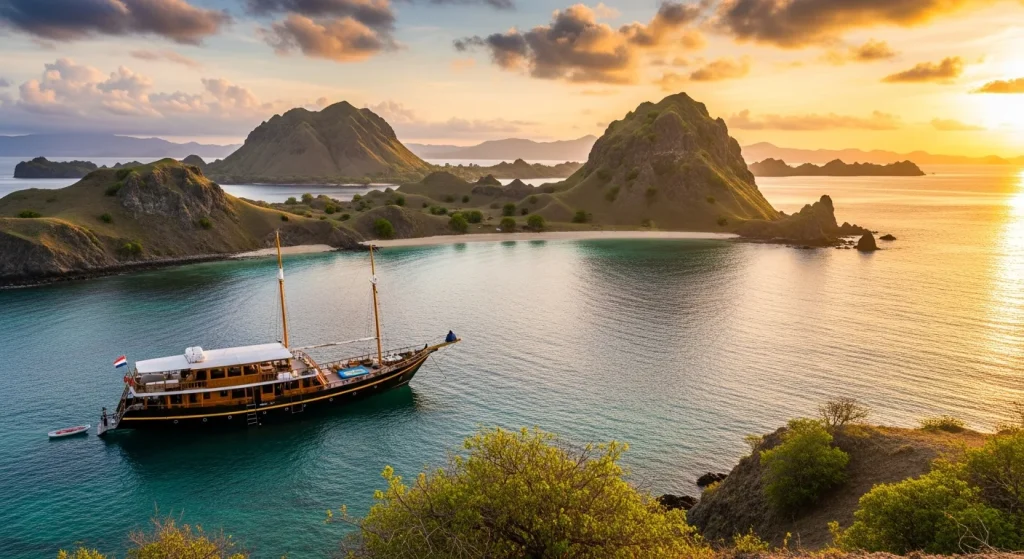
What to pack for a Komodo liveaboard, in one sentence: a soft
duffel with quick-dry clothes, reef-safe sunscreen, closed walking shoes
for dragon treks, motion-sickness tablets, a dry bag, cash in rupiah,
and half of what you were planning to bring. After 300+
departures on our 5-day Komodo trip, I’ve watched
thousands of guests unpack — and the same ten items get forgotten, and
the same ten items never leave the bag. This is the list I now send to
every confirmed guest before boarding.
The Golden Rule: Soft Bag,
Small Bag
Phinisi cabins are beautiful and compact. Hard-shell suitcases don’t
fit under beds and end up living in the corridor. Bring a soft
duffel or backpack, 40–60 litres, and leave the big suitcase at
your Bali hotel or with our Labuan Bajo partner office — most guests on
the 5-day / 4-night
liveaboard route do exactly this. You genuinely need less than you
think: laundry isn’t happening, nobody dresses up, and you’ll live in
swimwear from 07:00 to sunset.
Clothing: The 5-Day Formula
Eleven seasons of watching what people actually wear:
- 3–4 swimsuits. This is the real uniform. With two
swims a day, having a dry one to change into is the single biggest
comfort upgrade on board. - 2–3 quick-dry T-shirts / rash guards. A long-sleeve
rash guard doubles as sun protection at Manta Point, where you’ll float
on the surface longer than you expect. - 1 pair of lightweight trousers or leggings. For the
Padar sunrise climb (it’s breezy at 05:30) and dragon treks through
savanna grass. - 2 pairs of shorts, 1 sarong. The sarong is the most
versatile item on this list — beach mat, sun cover, modesty layer for
village visits. - 1 light windbreaker or fleece. July–August nights
on deck get genuinely cool; guests are always surprised. - Closed shoes with grip. Trail runners are ideal.
Padar’s steps are volcanic gravel and the Komodo trails are uneven —
flip-flops send someone sliding every season. - Flip-flops / sandals for the boat. Bare feet on
deck is the norm. - Hat with a strap and polarised sunglasses. The
strap matters; the crossing to Padar eats unsecured hats.
Sun, Skin, and Sea
- Reef-safe sunscreen, SPF 50, more than you think.
Komodo National Park is a UNESCO World Heritage marine site with some of
the richest coral in the world (source: UNESCO World Heritage Centre,
“Komodo National Park”) — oxybenzone-based sunscreens damage exactly
what you came to see. Buy before Labuan Bajo; local selection is thin
and pricey. - After-sun aloe. The equatorial sun at 8° south is
stronger than whatever you’re calibrated to. - Insect repellent. For land stops and the Labuan
Bajo evening, not the open sea. - Motion-sickness tablets. Even in calm season. Take
one before the longer crossings (Day 1 afternoon, Day 4). Full strategy
in our seasickness guide. - Personal medication + basic first aid. Boats carry
kits, but bring your own blister plasters, rehydration salts, and any
prescriptions. The nearest pharmacy is hours away by sea.
Gear Worth Its Weight
- Dry bag (10–20 L). Every landing is a wet landing
by dinghy. Phones, cameras, and passports ride in the dry bag,
always. - Your own snorkel mask if you’re picky. Boats
provide full sets, and good ones on the vessels we contract — but a
personal mask that fits your face is a luxury that costs nothing in
space. - Power bank (big one) + Indonesian plug adapter (Type C/F,
230V). Cabins have sockets but generators rest at night on some
boats. - GoPro or phone dome/float. The manta encounters are
the footage of the trip. A simple float strap has saved four guest
phones that I’ve personally watched go overboard. - Reusable water bottle. Every boat we use has refill
stations; single-use plastic is banned from our charters and
increasingly restricted in the park. - Headlamp or phone torch for deck walks after
generator-off. - Cash: IDR 1.5–2.5 million per person. Park fees are
usually prepaid in your package (check ours — they are), but crew tips,
drinks on some boats, and Labuan Bajo extras are cash affairs. ATMs
exist in Labuan Bajo only.
What Guests Always Forget
From my pre-departure checklist audits, in order of frequency:
seasickness tablets, dry bag, closed shoes, enough sunscreen,
power bank, a warm layer, spare swimsuit, cash, plug adapter, and
printed/offline copies of flight details (signal disappears an
hour out of port — download offline maps and your boarding passes before
departure).
What to Leave Behind
Hairdryers (won’t run on most boat generators), drones (permit
required in the park — see the park rules before you even pack one),
hard suitcases, heels or “nice” shoes, jewellery you’d cry about losing,
and full-size toiletries. Boats provide towels, snorkel gear, drinking
water, and all meals. If you’re combining boat and land nights on our
combo route, you can split your luggage and travel even lighter on the
boat leg.
Season Adjustments
- June–August (dry, windy): add the warm layer, skip
nothing else. Seas are livelier — tablets matter more. - September–November (calmest, hottest): double the
sunscreen, add electrolyte sachets. - December–March (rainy season): a packable rain
shell and a second dry bag. Squalls pass fast but soak completely.
The Printable Version
Every confirmed guest gets this list as a one-page PDF with
boat-specific notes (socket types, towel policy, whether your boat has
hairdryer-capable power — a few premium phinisi do). Boat-by-boat
details live on our liveaboard route
page.
Not booked yet? Tell me your dates and group size on the inquiry page and I’ll match you to the right boat —
or WhatsApp me directly at wa.me/6281139414563 and I’ll send
the packing PDF today.
Yohanes “Jo” Rangga has run the 5-day Komodo route since 2016 —
300+ departures. He still checks the forecast for every boat, and still
reminds every guest about the seasickness tablets.