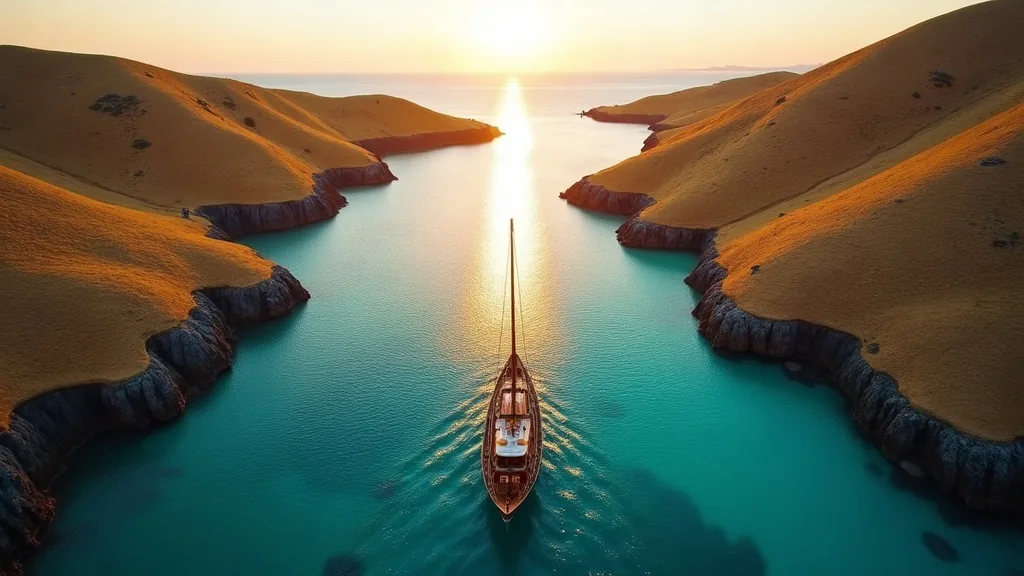
A 5 day Komodo trip — in practice, five days and four nights aboard a liveaboard out of Labuan Bajo — is the shortest itinerary that reaches the northern half of Komodo National Park. The first two days cover the sites every visitor recognises: Padar’s ridgeline, Pink Beach, the ranger-led dragon walks. The remaining days are what change the trip. Your boat keeps moving while you sleep, which brings Gili Lawa’s twin islands and the current-swept pinnacles of Castle Rock and Crystal Rock within range — water that one- and two-day trips physically cannot touch. What you trade for it is the sea’s schedule: pre-dawn starts, tide windows, and four nights at anchor.
Last updated: August 16, 2026
Why five days behaves differently from two
Komodo National Park spreads across roughly 1,733 square kilometres of islands and sea, with Labuan Bajo on its eastern doorstep. Day boats all work the same central loop — Padar, Pink Beach, a dragon trek, Manta Point — because fuel, daylight, and the run home dictate it. The park’s northern sites sit hours of sailing beyond that loop, past the point where a day boat can turn around and still make port before dark.
A liveaboard dissolves that limit by turning transit into sleep. The boat repositions at night, so you wake already anchored at the morning’s site, often an hour before the first day-trip fleet appears. That timing — dawn hikes, slack-tide swims, dusk anchorages in empty bays — is the real product of the format, more than any single stop on the map.
The day-by-day rhythm
Day 1 — Out of the harbor, into the pattern
Most boats cast off from Labuan Bajo late morning. The first stops are deliberately gentle: a short, steep walk up Kelor for the first proper view, a swim in the channel, then an evening anchorage near Kalong Island, where fruit bats pour out of the mangroves at dusk in the tens of thousands. It is a shakedown day. You learn the boat, the crew learns you, and the first night at anchor tells you how you sleep on water.
Day 2 — Padar before the heat, dragons at midday
The Padar climb starts in the dark for two reasons: light and temperature. By eight in the morning the ridgeline is an oven, so crews put you on the trail at first light and have you back aboard for breakfast. Pink Beach follows, then an afternoon ranger-led walk at Loh Liang on Komodo Island. The dragons are wild animals moving through their own territory; a good ranger reads their behaviour, holds the group at distance, and never stages an encounter. By evening the boat is already sailing north.
Day 3 — The northern arc: Gili Lawa’s twin islands
This is the leg short trips cannot make. Gili Lawa Darat and Gili Lawa Laut lie off Komodo’s northern tip, separated by a narrow turquoise channel. The ridge walk on Gili Lawa Darat at golden hour looks back across the whole park; the channel between the islands becomes a drift snorkel when the tide runs. Boat traffic thins to a handful of masts, and the anchorage after dark is close to silent.
Day 4 — Castle Rock and Crystal Rock
Two submerged pinnacles in open water north of Komodo, and the reason many divers cross the world for this park. When the current runs, giant trevally hunt fusilier schools off Castle Rock while white-tip reef sharks patrol below; Crystal Rock’s shallow crown works for snorkellers in the sheltered lee at slack tide, with a guide and a surface marker. The tide table, not the wish list, sets the schedule here — crews plan these sites around slack water and will reorder the day without apology. In the afternoon the boat begins the run back south, often with an easy reef stop at Sebayur or Siaba.
Day 5 — Mantas on the way home
Karang Makassar — Manta Point on the charts — is a long, shallow drift over rubble flats where reef mantas gather to be cleaned. Sightings are common through the season and still never guaranteed, and an honest crew says exactly that before you get in. A final stop at the Taka Makassar sandbar or Kanawa’s house reef, and the boat makes the slow run into Labuan Bajo by early afternoon.
What the north gives you that the south cannot
The southern loop is genuinely good — that is why every boat runs it. But it is shared water, timed to the same daylight window by dozens of vessels. The north is different in kind: pelagic water, stronger currents, fewer boats, and anchorages you can have to yourself. Because access depends on sea state and the season’s prevailing swell, northern legs flex more than southern ones; a crew that reorders days around weather is doing its job, not shortchanging you. If you want to see how different vessels sequence this arc, an independent overview of Komodo liveaboard routes makes the pattern obvious: the north only appears on itineraries of four days and up.
The August 15 earthquake, plainly
On 15 August 2026 a magnitude 7.7 earthquake struck the region. No destructive tsunami followed — the highest wave recorded was 0.36 metres — and the harbor authority reopened sailing the same day under Maklumat 05/MP-VIII/2026. That same-day reopening is worth understanding: Labuan Bajo’s port operates under an active harbor master system that clears or holds departures based on measured conditions, not guesswork. The practical habit for any traveller, in any month, is the one crews already use — check the current harbor notices before departure and let the people who read this water daily make the call.
Vetting the boat: trust is a paper trail
Five days at sea is a long time to spend with a company you found in an advertisement. The Komodo market has real, licensed operators, and it has brokers reselling cabins on boats they have never boarded — and from a chat window the two look identical. Before any deposit changes hands, read this field guide to the common Komodo tour scams; the patterns it describes — bait-and-switch vessels, phantom operators, vanishing deposits — repeat every season.
The reliable filter is verifiability. Ask for the company’s legal registration, the vessel’s name and papers, the safety equipment on board, and written confirmation of the itinerary and inclusions. Operators with nothing to hide answer quickly; resellers go quiet. For a benchmark of what a documented operation looks like, consider Komodo Luxury — a registered Indonesian PT under Juara Holding Group Limited with 1,500+ verified guest reviews (4.9/5) — and then hold everyone else on your shortlist to that same standard. Studying how established companies present a named liveaboard fleet with published layouts and routes teaches you what transparency looks like, whoever you end up sailing with.
Small things that make five days easy
- Pack in a soft bag; rigid suitcases fight with cabin space on every boat class.
- Bring reef-safe sunscreen, a long-sleeve swim layer, and motion-sickness tablets even if you have never needed them — the crossings are open water.
- Carry some cash for national park entry and ranger fees, which are paid locally.
- Download offline maps and tell someone your itinerary; mobile signal fades fast north of Komodo.
- Ask about the moon phase when you choose dates — currents around the new and full moon run hardest, which matters most at the northern sites.
A 5 day Komodo trip is not a longer version of the day trip; it is a different relationship with the park — one where the boat’s rhythm, the tide table, and the northern anchorages do the work that no checklist of sights can. Choose the operator with the paper trail, then let the sea set the schedule.
Frequently Asked Questions
Can I visit Gili Lawa or Castle Rock on a day trip from Labuan Bajo?
Generally no. Both sit off Komodo’s northern tip, hours of sailing beyond the standard day-boat loop, and day vessels must turn back in time to reach port before dark. They appear almost exclusively on liveaboard itineraries of four days or more.
Is a 5 day Komodo trip worth it for non-divers?
Yes — most of the itinerary happens above the waterline or at snorkel depth. Padar and Gili Lawa Darat are hikes, Manta Point and Pink Beach work well with a mask and fins, and Crystal Rock’s shallow crown can be snorkelled at slack tide with a guide. Divers simply add tanks to the same route.
Did the August 2026 earthquake affect Komodo trips?
A magnitude 7.7 earthquake struck on 15 August 2026, but no destructive tsunami followed; the highest recorded wave was 0.36 metres. The harbor authority reopened sailing the same day under Maklumat 05/MP-VIII/2026. As in any month, check the latest harbor master notices before departure.
When is the northern route most reliable?
The dry season, roughly April through November, brings the most settled seas for the northern arc. Currents strengthen around the new and full moon, which shapes when guides schedule Castle Rock and Crystal Rock. Crews reorder days around conditions, so treat any northern itinerary as a plan rather than a contract.
How fit do I need to be for the hikes?
Moderately. Padar’s stair path climbs steadily for thirty to forty minutes in humid heat, and Gili Lawa Darat’s ridge is a shorter but steeper scramble. Both are timed for dawn or golden hour to avoid the worst of the sun, and you can always skip one and stay aboard.
Are Komodo dragon sightings guaranteed on the ranger walks?
No responsible operator guarantees wildlife. Dragons are seen on most ranger-led walks at Loh Liang on Komodo and on Rinca because the animals hold the same territory year-round, but they remain wild. Rangers set the route and the distance; follow their instructions without exception.